


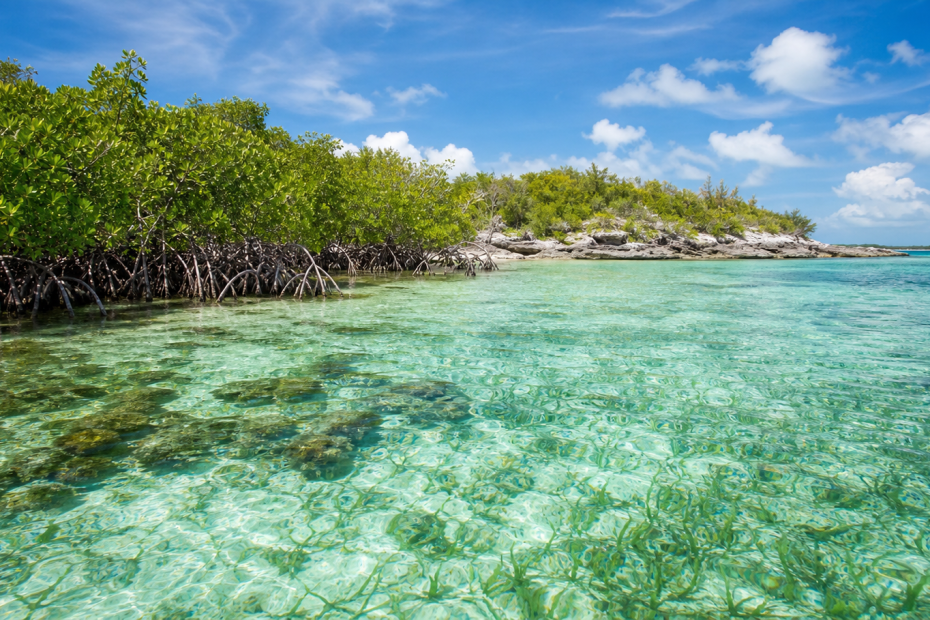
The Bahamas is often introduced through colour: water so blue it seems lit from within, sandbars that appear and disappear with the tide, pink shells, green mangroves, silver bonefish flats, and reefs alive with movement. But the real story of the Bahamas environment is not only beauty. It is stewardship.
Across more than 700 islands and cays, Bahamians are protecting ecosystems that hold together everyday life: reefs that soften waves, mangroves that shelter young fish, blue holes that preserve ancient natural records, pine forests that support rare birds, and seagrass beds that feed turtles and store carbon. In a country where land and sea are inseparable, conservation is not a side issue. It is a cultural, economic, and generational responsibility.
Why is the Bahamas environment so important?
The Bahamas is one of the great marine nations of the Caribbean. Its identity, food traditions, tourism economy, fisheries, boating culture, and sense of place are all tied to healthy coastal ecosystems. The Bahamas Protected Areas Fund notes that the country is roughly 95 percent water, which means environmental protection in The Bahamas is, by necessity, ocean protection.
That ocean is not a blank blue space. It is a living network. Coral reefs provide habitat for fish and marine life. Seagrass beds help stabilize shallow bottoms and provide feeding grounds. Mangroves act like nurseries for juvenile fish, conch, crawfish, crabs, and birds. Wetlands absorb water and reduce flooding. Pine forests and coppice support endemic plants and wildlife. When these systems are healthy, communities are safer, food systems are stronger, and visitors experience a Bahamas that still feels alive rather than merely scenic.
Protected areas are the backbone of Bahamian conservation
One of the clearest ways The Bahamas protects its environment is through national parks, marine managed areas, forest reserves, wetlands, wild bird reserves, and other protected areas. These places give ecosystems the space and legal recognition they need to recover, function, and support surrounding communities.
The Protected Areas Register lists sites across islands including Abaco, Andros, Exuma, Grand Bahama, New Providence, San Salvador, Acklins, Mayaguana, and more. The range matters. Environmental protection cannot happen only in famous tourist waters. It must also reach tidal creeks, pine forests, inland blue holes, bird habitat, nursery flats, and quiet coastlines where ecological value may not be obvious at first glance.
The Bahamas has long been a regional leader in marine protection. The Exuma Cays Land and Sea Park, established in 1958, is widely celebrated as one of the world’s first land-and-sea parks and a model for marine conservation. The Bahamas National Trust describes it as a place where protection helps replenish fish stocks and supports research, education, and long-term marine health.
What role do mangroves, reefs, and seagrass play?
Mangroves, reefs, and seagrass are often discussed separately, but in The Bahamas they work as one coastal defense and biodiversity system. A young fish may shelter in mangrove roots, feed across seagrass, and later move to reef habitat. A storm surge may be slowed by reef structure before reaching mangrove wetlands. A turtle may graze seagrass in the same coastal mosaic that supports local fisheries and nature-based tourism.
That connectedness is why protecting one habitat while allowing another to decline is never enough. Reefs need clean water. Seagrass needs healthy coastal conditions. Mangroves need room to migrate and recover after storms. The Bahamas environment depends on decisions that respect the full coastal system, not only the most photogenic parts of it.
Groups such as BREEF, the Bahamas Reef Environment Educational Foundation, help make this connection visible through reef education, restoration, ocean literacy, and youth engagement. Their work is important because conservation becomes stronger when young Bahamians see the ocean not as background scenery, but as inheritance.
How is The Bahamas protecting biodiversity for future generations?
The answer is layered: legal protection, park management, conservation finance, education, research, restoration, and community awareness all play a role. The Bahamas Protected Areas Fund was established to help create sustainable financing for the national protected areas system, including support for national parks, biodiversity conservation, wetlands, blue holes, carbon sinks, degraded ecosystems, and areas important for climate adaptation.
This is a crucial point. Declaring a protected area is only the beginning. Parks need rangers, monitoring, signage, moorings, science, community partnerships, enforcement, and long-term funding. Without those pieces, a protected area can exist on paper while ecosystems remain vulnerable in practice. Sustainable financing helps move conservation from intention to action.
That work also intersects with local pride. A protected blue hole is not only a geological feature. A mangrove creek is not only a fish nursery. A reef is not only a tourism attraction. These places carry memory, livelihood, science, recreation, and identity. Protecting them means protecting the conditions that allow Bahamian culture to remain rooted in place.
Climate change makes protection more urgent
Like many low-lying island nations, The Bahamas faces serious climate pressures: stronger storms, sea-level rise, coral stress, coastal erosion, saltwater intrusion, and the cost of rebuilding after extreme weather. Conservation cannot stop climate change by itself, but healthy ecosystems can reduce vulnerability.
Mangroves buffer shorelines. Reefs reduce wave energy. Wetlands store water and support biodiversity. Seagrass beds capture carbon and stabilize marine environments. Pine forests and coppice provide habitat that helps species survive across islands. In this sense, environmental protection is also resilience planning. Nature is infrastructure, and in The Bahamas it is among the most valuable infrastructure the country has.
This is where the future of the Bahamas environment becomes a national conversation. Development, tourism, fisheries, housing, transportation, and climate adaptation all depend on land-use choices. The challenge is not to choose between progress and protection. It is to define progress in a way that leaves the natural systems stronger, not weaker.
Tourism can help when it respects the environment
Visitors come to The Bahamas for the natural world, even when they do not name it that way. A beach holiday depends on healthy sand systems. A snorkelling trip depends on living reefs. A bonefishing lodge depends on flats and mangrove nurseries. An island-hopping itinerary depends on clean water, protected cays, and wildlife that still has room to thrive.
That gives tourism a responsibility. Travellers can support conservation by choosing responsible operators, respecting park rules, avoiding reef-damaging behaviour, reducing single-use plastics, never disturbing wildlife, and learning from local guides. Businesses can invest in waste reduction, water conservation, reef-safe practices, and community-led environmental education. Government and conservation partners can keep expanding clear rules, enforcement, and public awareness.
For Exceptional Caribbean readers planning a broader Bahamian journey, related destination context can be found in Everything You Need to Know for the Best Vacation in Bahamas. But the deeper invitation is to see The Bahamas as more than a vacation image. It is a living archipelago whose beauty depends on care.
The role of local institutions and community knowledge
Environmental protection in The Bahamas is not carried by one institution alone. It involves public agencies, the Bahamas National Trust, the Bahamas Protected Areas Fund, BREEF, scientists, educators, fishers, tour operators, youth groups, and communities across the islands. Each brings a different kind of knowledge.
Scientific monitoring can show reef health. Fishers can describe changes in seasonal abundance. Guides know where seagrass is scarred by careless anchoring. Elders remember coastlines before major development. Young people bring urgency and imagination. The strongest conservation culture listens across these forms of knowledge, because the environment is both a scientific system and a lived home.
Exceptional Caribbean has previously highlighted regional conservation institutions such as the Bahamas National Trust and the Bahamas Protected Areas Fund. Their work reflects a wider Caribbean truth: small island environments are not small in importance. They are central to food security, cultural identity, climate resilience, and the region’s global ecological value.
What can readers do to support the Bahamas environment?
The most meaningful support begins with respect. Learn the rules before entering a national park. Use moorings where provided instead of anchoring on sensitive seabeds. Keep plastics out of beaches and creeks. Choose local guides and conservation-minded businesses. Support organizations doing long-term work. Share stories that show the Bahamas environment as a living system, not just a backdrop.
For Bahamians, protection is also a matter of intergenerational care: what kind of shoreline, reef, forest, fishery, and island memory will be passed on? For visitors, it is a matter of gratitude: how do you leave a place as beautiful as you found it, or better?
A blue future worth protecting
The Bahamas reminds the Caribbean and the world that environmental beauty is never accidental. It survives through choices: what is protected, what is restored, what is taught, what is funded, and what is refused.
Protecting the natural environment of The Bahamas means protecting the reefs that feed the sea, the mangroves that cradle young life, the blue holes that hold ancient mystery, the forests that shelter birds, and the communities whose futures are tied to all of them. It is a national responsibility, a Caribbean priority, and one of the most hopeful stories the region can continue to tell.
Explore more stories in the Exceptional Caribbean Environment category.
