



Grace Jones
The Avant-Garde Empress of the Caribbean
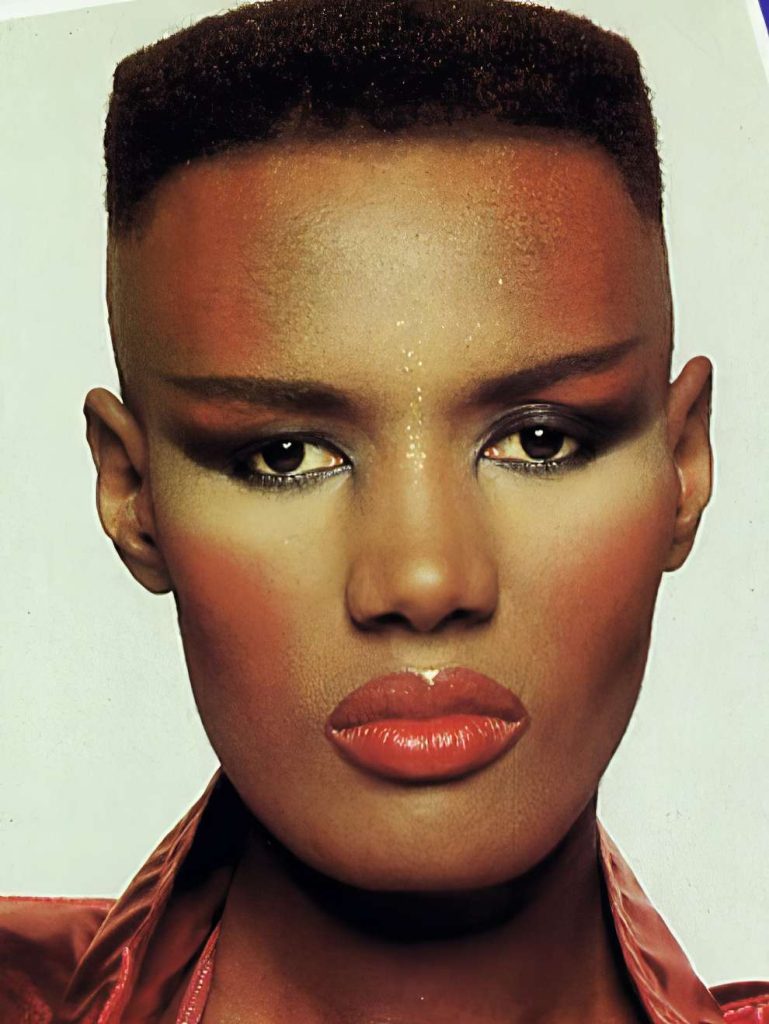
Grace Jones is one of the Caribbean’s most influential cultural icons, whose fearless creativity transformed global fashion, music, and film. Born in Jamaica, she challenged traditional standards of beauty, identity, and performance long before such conversations became mainstream. Through her groundbreaking style, genre-blending music, and commanding screen presence, Jones helped redefine international perceptions of Caribbean creativity as bold, innovative, and globally influential. Her legacy continues to inspire generations of artists and performers around the world.
Long before conversations surrounding identity, reinvention, gender fluidity, Afrocentric aesthetics and creative disruption became part of global mainstream culture, Grace Jones was already living them – boldly, unapologetically and theatrically.
From the historic town of Spanish Town Jamaica to the glittering fashion salons of Paris, the pulsating nightlife of New York and the sound stages of Hollywood, Grace Jones carried with her an unmistakable Caribbean force: fearless self-invention grounded in resilience, rhythm, discipline and survival.
Her story continues to inspire generations across fashion, music, film and contemporary visual culture.
HER CARIBBEAN ROOTS
Born on May 19, 1948, in Jamaica, Grace Beverly Jones spent her formative years within a strict Pentecostal environment shaped by religious discipline and deeply traditional Caribbean values. The intensity of that upbringing would later become central to the commanding persona that fascinated the world.
Jones herself would often reflect on how the rigour of her childhood forged the mental toughness and precision that later defined her career.
The Jones family eventually relocated abroad in search of broader opportunities, settling in Syracuse while Grace was still a teenager. Yet migration did not dilute her Caribbean identity. Existing between cultures gave Jones a heightened awareness of race, visibility, performance and belonging.
HER PLACE IN INTERNATIONAL FASHION
Grace Jones emerged at a time when the fashion and entertainment industries were still dominated by narrow Eurocentric definitions of beauty and femininity. She challenged all of it.
After beginning her modelling career in New York with Wilhelmina Models, she relocated to Paris in the early 1970s – a move that would transform her into an international sensation. Parisian fashion circles immediately recognised something extraordinary in her striking appearance. Her sculpted cheekbones, statuesque frame, dark complexion and androgynous energy stood in radical contrast to conventional modelling standards of the era.
Grace appeared on the covers of prestigious international publications such as Elle and Vogue Hommes, while collaborating with legendary photographers such as Helmut Newton and Guy Bourdin. She modelled for iconic fashion houses including Yves Saint Laurent and Kenzo, quickly becoming one of the most recognisable Black models of her generation.
Grace Jones transformed fashion into visual performance art. Her collaboration with French illustrator and art director Jean-Paul Goude produced some of the most iconic imagery of twentieth-century pop culture.
Together, they constructed a visual language built on sharp geometry, surrealism, theatricality and Afro-futuristic elegance. The angular flattop hairstyle, sculptural poses and hyper-stylised aesthetic associated with Jones would influence generations of performers and designers for decades to come.
Today, many cultural historians credit Grace Jones as one of the earliest Black models to successfully bridge the elite European couture world and global mainstream celebrity culture — helping to expand international perceptions of Black beauty long before diversity became a fashionable industry conversation.
Her impact can still be seen in artists such as Rihanna, Lady Gaga and Annie Lennox, all of whom inherited aspects of the visual fearlessness Jones pioneered.
MUSIC, REINVENTION, AND CULTURAL FUSION
Emerging from the electric nightlife ecosystem surrounding Studio 54, Jones initially found success during the disco era. Yet unlike many artists trapped by the trends of their time, she continually reinvented herself.
What made Grace Jones musically extraordinary was her refusal to recognise boundaries between genres. She fused reggae, funk, electronic music, new wave, synthesizer pop and Caribbean rhythmic sensibilities into an avant-garde sound that was years ahead of its time.
Her albums – particularly Warm Leatherette, Nightclubbing and Slave to the Rhythm – are now widely regarded as pioneering works that anticipated the genre-fluid direction of modern pop music.
Songs such as Pull Up to the Bumper and Slave to the Rhythm carried a hypnotic sophistication rooted partly in Caribbean rhythm structures and performance traditions. Her deep, commanding vocal delivery stood apart from the polished vocal styles dominating commercial radio at the time.
Grace Jones sounded unlike anyone else because sameness was never part of her artistic DNA.
CONTRIBUTION TO INTERNATIONAL MUSICAL EXCELLENCE
Grace Jones’ recording in Nassau Bahamas with Compass Point All Stars – an extraordinary collective of Caribbean and international musicians – with their innovative fusion of reggae rhythms and electronic production profoundly influenced post-punk, synth-pop and alternative dance music throughout the 1980’s.
Music historians today frequently cite those sessions as foundational to the evolution of modern experimental pop.
The prestigious Billboard Magazine has ranked Grace Jones among the greatest dance club artists of all time; an achievement reflecting not merely commercial success, but enduring cultural relevance.
HER HOLLYWOOD IMPACT
Grace Jones also conquered cinema with the same intensity she brought to music and fashion. Her performances radiated strength, mystery, and danger at a time when Black women in Hollywood were rarely granted such multidimensional roles.
She captivated audiences as the fierce warrior Zula in Conan the Destroyer and achieved global mainstream recognition as May Day in the James Bond classic A View to a Kill opposite Roger Moore.
Importantly, Grace Jones did not merely appear in films – she disrupted cinematic stereotypes. Her characters projected physical dominance, intellectual confidence and sexual autonomy, challenging traditional portrayals of femininity within mainstream Western cinema.
In an era when Hollywood often marginalised Black actresses, Jones created unforgettable screen presences that could neither be ignored nor categorised.
IN CONCLUSION
Yet perhaps Grace Jones’ greatest contribution lies beyond any individual achievement in fashion, music or film. Her true significance is cultural.
Grace Jones helped expand the global understanding of what Caribbean creativity could look like. Through her work, the Caribbean emerged as futuristic, intellectual, avant-garde, experimental and globally transformative. She reminded the world that Caribbean identity is not a limitation, it is a creative superpower.
Today, the influence of Grace Jones echoes across international fashion runways, music videos, visual art, performance culture and contemporary celebrity branding. Yet beneath the global iconography remains a distinctly Caribbean core: the discipline of a Jamaican upbringing, the resilience of migration, the rhythm of island culture and the audacity to stand unapologetically apart from the crowd.
In many ways, Grace Jones represents the Caribbean at its most exceptional – bold enough not merely to participate in global culture, but powerful enough to redefine it.
Raised in multicultural and multi-religious societies where diversity, creativity, resilience, and community are part of everyday life, Caribbean people bring a unique perspective to the world. It is this spirit of diversity, resilience and openness that continues to fuel extraordinary Caribbean talent across the world – from music, art, culture, sports, cuisine, science, technology, philanthropy, academia, literature, and more.
Grace Jones is one such figure.
Exceptional Caribbean celebrates and showcases the very best of the Caribbean and shines a spotlight on the people, stories, and experiences that make the Caribbean truly exceptional.
Follow Exceptional Caribbean for more authentic Caribbean stories.
